Same Model, Different Harness, Worlds Apart: I Read DeepSeek Harness's Source. Here's What's Actually New.

The model is the soul. The harness is the body.
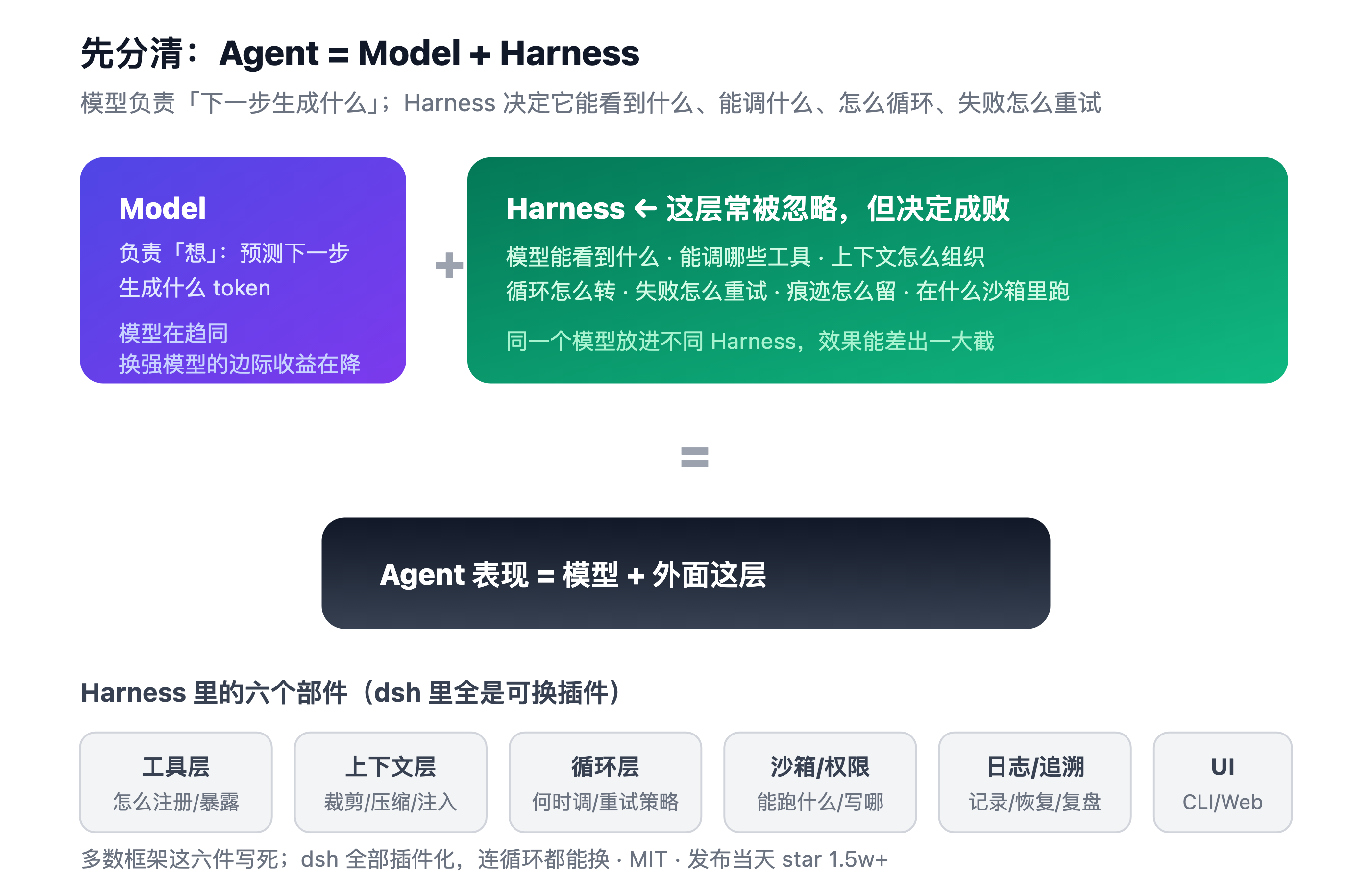 The model thinks. The harness does.
Hi, I'm Booker.
Today I'm taking apart DeepSeek Harness (dsh), open-sourced by DeepSeek yesterday (2026-08-13).
This is not a secondhand recap. I read the source and the official docs. I'll walk through its three real design decisions, pour some cold water, and honestly tell you my first run failed.
Start with three questions
Three scenarios. You've probably hit at least one.
First. You ran a long agent task. It failed after hours. Can you tell which tool call it died on? Can you reconstruct what context the model was actually seeing?
Second. You wanted to add a rule: "after a tool call fails, retry once." Can you add it? Or do you have to fork the framework?
Third. You wanted three agents working together: one researching, one writing code, one reviewing. They come from different ecosystems — one speaks MCP, one speaks ACP, one speaks Hooks. Can you wire them together?
This article is about those three questions.
DeepSeek's answer for dsh fits in three words: everything is a plugin. But "everything is a plugin" is easy to misunderstand. Read on.
A model doesn't do things. It generates text.
Start at the most basic place.
You ask ChatGPT a question. It answers. At this point you have no concept of a "harness," and you don't need one. It's a thing that generates text: you feed it a sentence, it produces the next one.
The trouble starts when you ask it to do something.
Say: "fix the code in this project." To fix code, it needs to read files, find the error, edit it, run tests. The model can do none of that.
A model does exactly one thing: predict the next token. What it generates isn't "the act of fixing code" — it's text describing how to fix it.
So who actually reads files and runs commands?
Something outside the model has to wrap those real actions into a form the model can "call." The model says "read src/main.ts"; this layer reads it and feeds the content back.
That layer is the Harness.
The official site puts it better than I can:
"The model is the soul of the agent. The Harness gives the agent the ability to understand its environment, use tools, and keep working in real scenarios."
Here's the non-obvious part: most people don't know this layer exists. We say "switch models, switch agents." But the same model inside a different harness can perform dramatically differently — how tools are exposed, how context is managed, how the loop runs — all of that is harness territory.
The moment things get complex, this layer has a lot to manage
If "read one file" were all it did, a thin wrapper would be enough. Real tasks aren't like that.
Back to "fix the code." A real fix task involves:
- The model says "read this file." First question: do you have permission? That's the sandbox's job.
- The file is huge. You need to trim or compress it before feeding it back. That's the context layer's job.
- Tests fail after the edit. Retry? How many times? That's the loop layer's job.
- Every step needs to be logged, or you'll never know where it died. That's the traceability layer's job.
- Should this run in a CLI, a web UI, or behind an IDE? That's the entry-point's job.
Every one of these needs someone to make decisions for the model. Those decisions all live in the Harness.
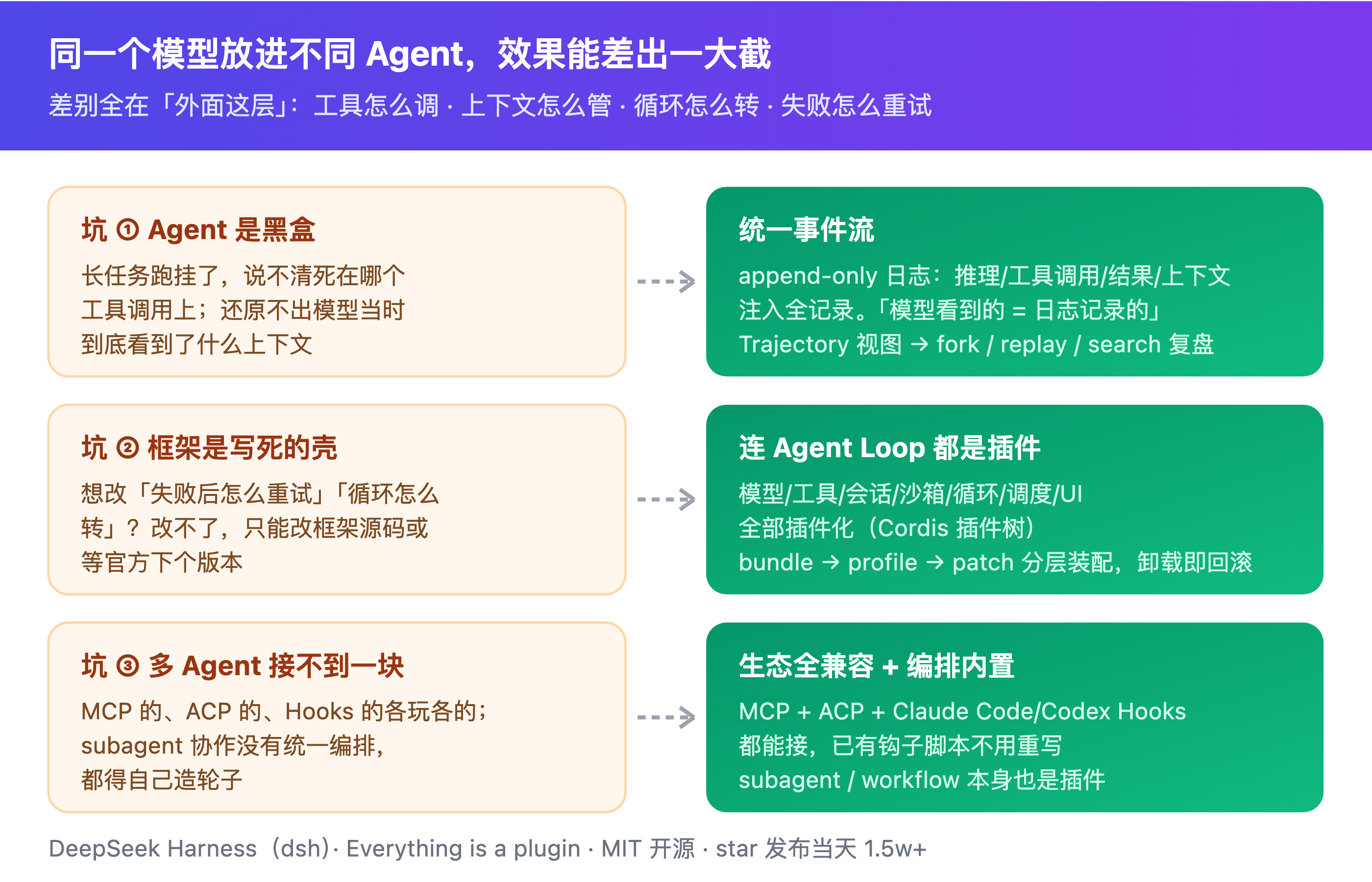 Three real pains, and the mechanisms dsh built for them
Here are the three pains everyone hits with Claude Code, Codex, or Cursor:
Pain 1: The agent is a black box. Long tasks die, and you can't tell where — or reconstruct what context the model was seeing.
Pain 2: The framework is a fixed shell. Want to change "retry behavior" or "how the loop turns"? You can't. Fork the source or wait for the next release.
Pain 3: Multi-agent doesn't fit together. MCP here, ACP there, Hooks somewhere else. No unified orchestration. You build your own wheels.
These aren't DeepSeek's inventions. They're industry-wide. dsh's value is that it has buildable mechanism answers to all three.
Design decision #1: even "how the loop turns" is a plugin
Let me correct my own earlier understanding first: a lot of people (including me, initially) read "everything is a plugin" as "you can add tools and skills." No. dsh's plugin system goes much deeper.
Reading the source, I found this in packages/core/agent-loop's README — the key to understanding dsh:
"This is the only package in the harness that contains concrete loop logic. Everything else is an abstract service or a plugin against extension points — new behavior goes into plugins, not here."
Translation: even "how the agent loop turns" is itself just a concrete plugin (agent-loop), not framework core. Model adapters, tool registry, session log, sandbox, UI, scheduling — all plugins in dsh, mounted on a plugin tree by Cordis.
How is it assembled? Three config layers: bundle → profile → patch.
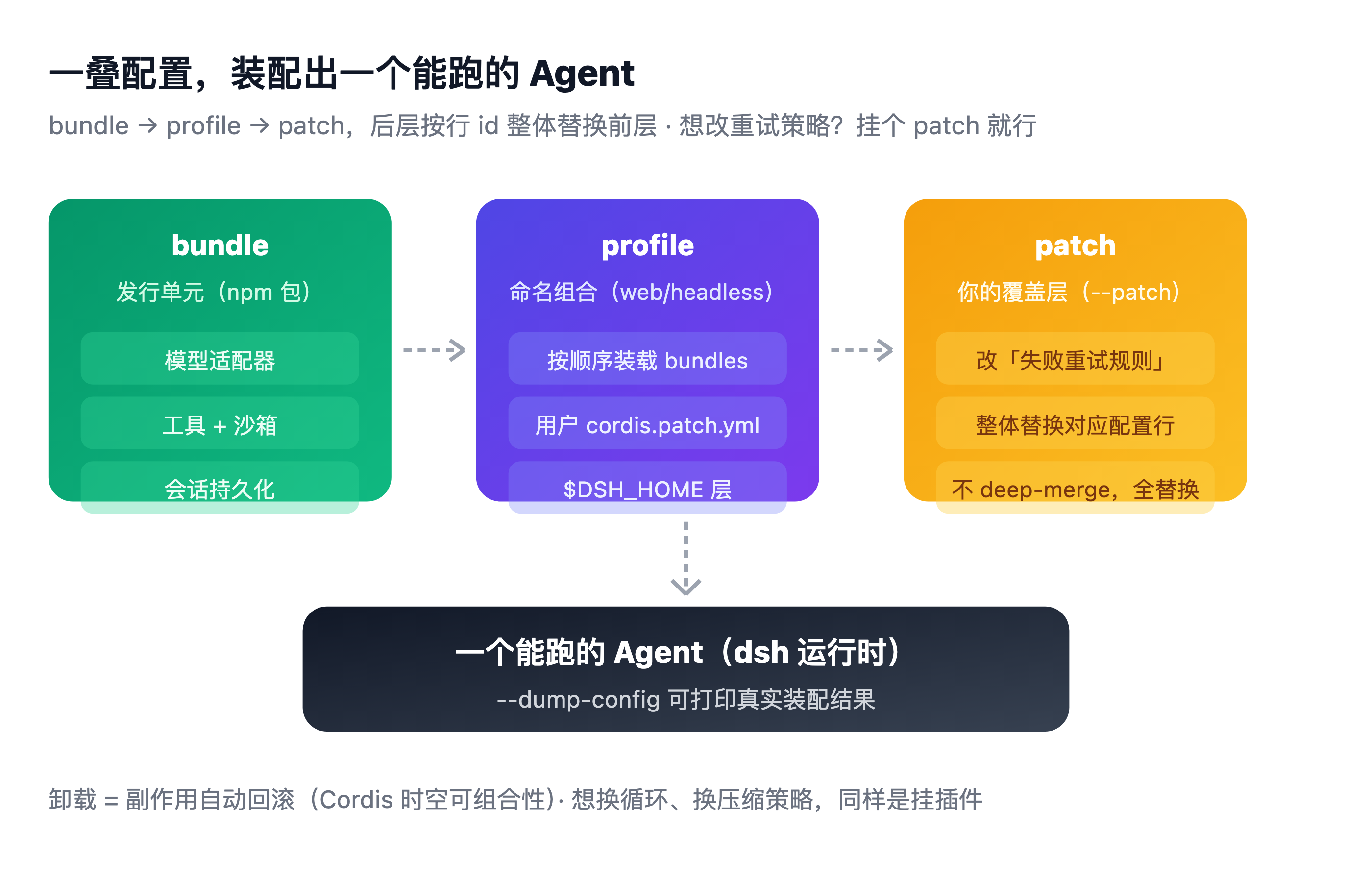 A stack of config, assembled into a running Agent
- bundle: a distribution unit (npm package); each bundle declares which config rows it contributes
- profile: a named composition that lists which bundles to stack (
webandheadlessship as templates) - patch: your overlay layer, replacing a config row wholesale by id
Want to change "retry after failure"? Don't touch source. Mount a patch that replaces that config entry. Want a different context-compaction strategy? Same thing.
And it's not a hacky "anything can mount." Cordis has a formal theory (spatiotemporal composability). The core guarantee: when a plugin unloads, its side effects roll back completely, as if it was never installed. Without that guarantee, plugin systems are toys. With it, deep replacement is real engineering.
dsh --profile web --dump-config prints the actual plugin tree your machine boots — every row is replaceable.
Design decision #2: PTC isn't "saving round trips," it's "redefining the tool surface the model sees"
This is the part I think is most interesting — and the part most write-ups get shallow.
Let me say where my own initial understanding was wrong: I thought PTC (programmatic tool calling) was "let the model write a program instead of making many tool calls." Right direction, but shallow.
Here's the truth from the source:
In PTC mode (officially called "PTC 模式" — PTC Mode, not "Code Mode"), the tool surface the model sees changes entirely.
The tool registry stays, but the presentation layer (tool-presentation) switches to code:
- The model sees only
run_codeplus a generated TypeScript SDK - The model can only directly call
run_code. If it calls any other tool directly, that call resolves toUNKNOWN_TOOLat execution-creation time — before approval and guards, because "nothing should observe or approve a call that can only fail" - The error message even points the way: "only
run_codeis callable directly — call<name>from inside arun_codeprogram instead"
Underneath is a design invariant called announced surface = callable surface. What the model sees must be exactly what the model can call.
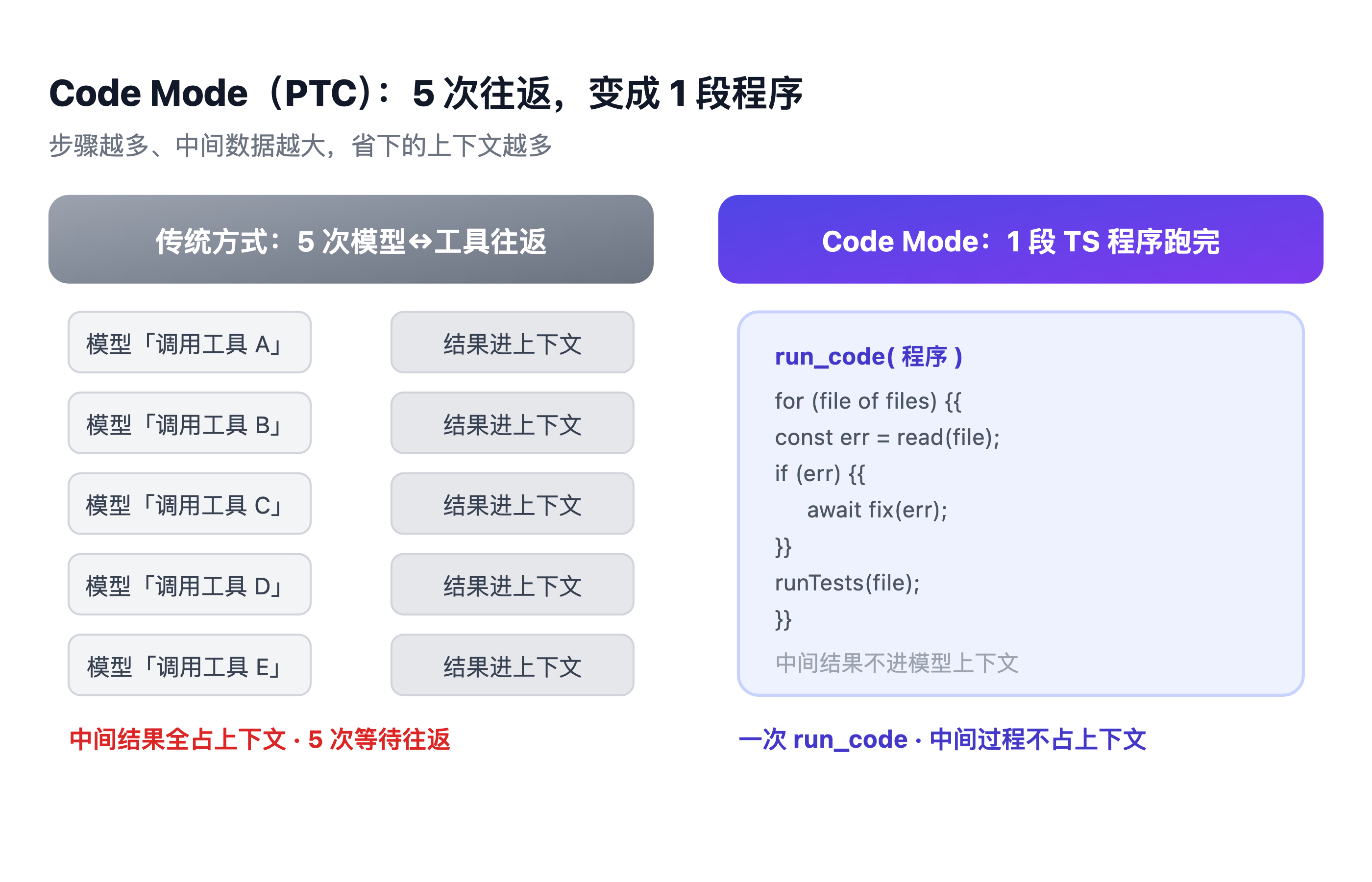 Traditional: 5 round trips. PTC: 1 program
So what does "5 round trips becomes 1" actually mean? From the code preset's config comment:
"the model writes a TypeScript program against a generated SDK and
run_codeexecutes it, so a sequence that would be five round trips becomes one."
Three design points that matter:
- The SDK is deterministic. Every visible tool has exact parameter and output types (
ToolArgsMap/ToolOutputMap). The model-written program never "guesses" a tool signature. - Intermediate values stay in the execution environment. Binding call results, logs, and intermediate computation live only in the worker thread. Only the program's final logs and return value re-enter model context. That's how context is saved.
- Tool calls inside the program still go through the full pipeline. Sandbox, approval, timeout, logging — nothing is skipped. It's not "bypassing," it's "compressing round trips."
I tried to run it (more on that below), but even just reading this mechanism was worth it.
Design decision #3: everything the model sees gets logged
How does dsh solve the black-box problem? Its approach is plain but hard:
Anything that reaches a model request must be reconstructable from the log.
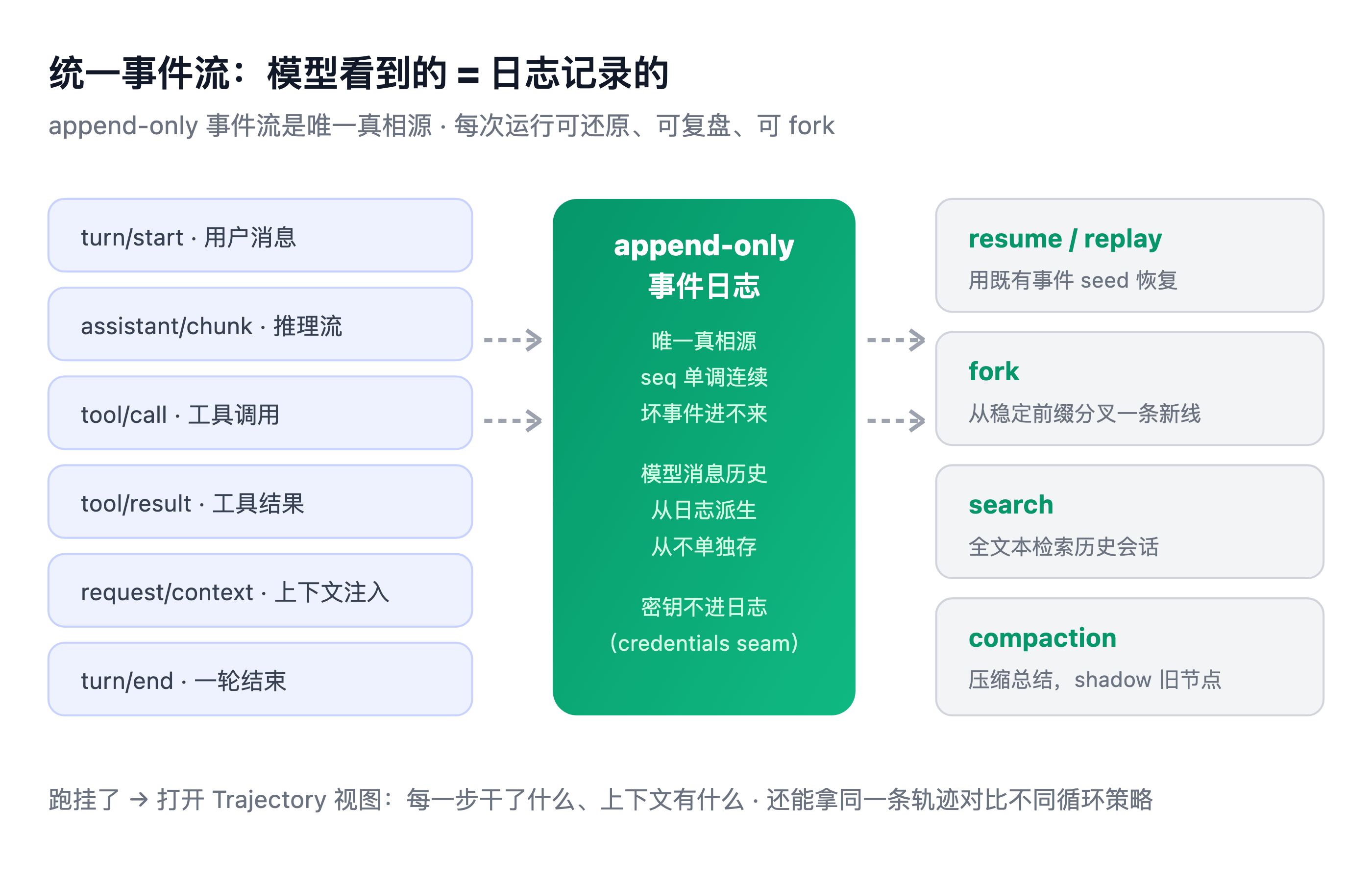 What the model sees = what's logged. Reconstructable, replayable, forkable
A session is an append-only SessionEvent stream — the single source of truth for the whole interaction history. The model's message history isn't stored separately; it's derived from the log.
What gets logged? System prompts, chain of thought, tool calls and results, sub-agent scheduling, every context injection. The official name for this invariant: model-visible ⟺ logged.
Long task died? Open the Trajectory view, see every step by source, and what context the model had at each one. Fork a line and rerun. Replay for postmortem.
Hidden bonus for tinkerers: run the same task trajectory against different loop strategies or tool implementations and compare. That was basically impossible before.
One more detail: secrets never enter the log. Credentials go through a separate credentials seam; the log only holds references (environment variable names), never values.
Four modes = four plugin combinations
dsh's official four modes — the names are easy to get wrong, so I verified them in the source preset.yml:
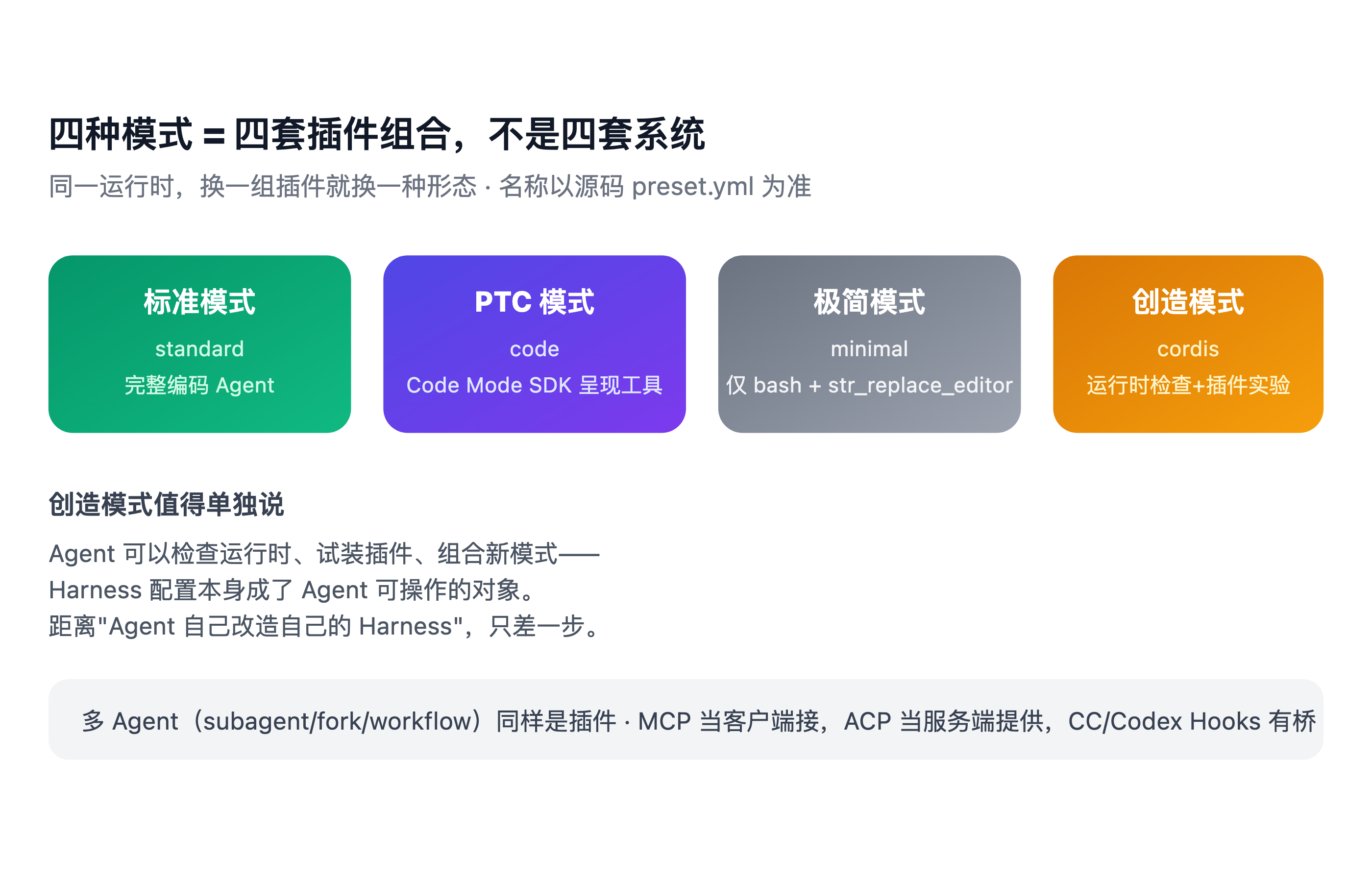 Standard / PTC / Minimal / Creator — four plugin combos
| Mode | Key | What it is |
|---|---|---|
| Standard | standard | Full-featured coding agent: file editing, Shell, file & web search, Skills, planning, goals, subagents, workflows |
| PTC | code | Everything in Standard, but tools are presented via a Code Mode SDK (the thing from the last section) |
| Minimal | minimal | Exactly two tools: persistent bash + str_replace_editor. Official note: "for model benchmarking in minimal environments" |
| Creator | cordis | Everything in Standard, plus runtime inspection, plugin experimentation, and preset-creation guidance |
Two observations:
Minimal mode's existence shows DeepSeek itself cares about benchmarks. Yet BENCHMARK.md only explains how to run them — no published results. I'll come back to that contrast.
Creator mode is the most imaginative. It ships a tool-cordis plugin: the agent can inspect its own runtime plugin tree and mount/unmount model-written plugins. In other words: the harness config itself becomes something the agent can operate on. "An agent reshaping its own harness" is one step away.
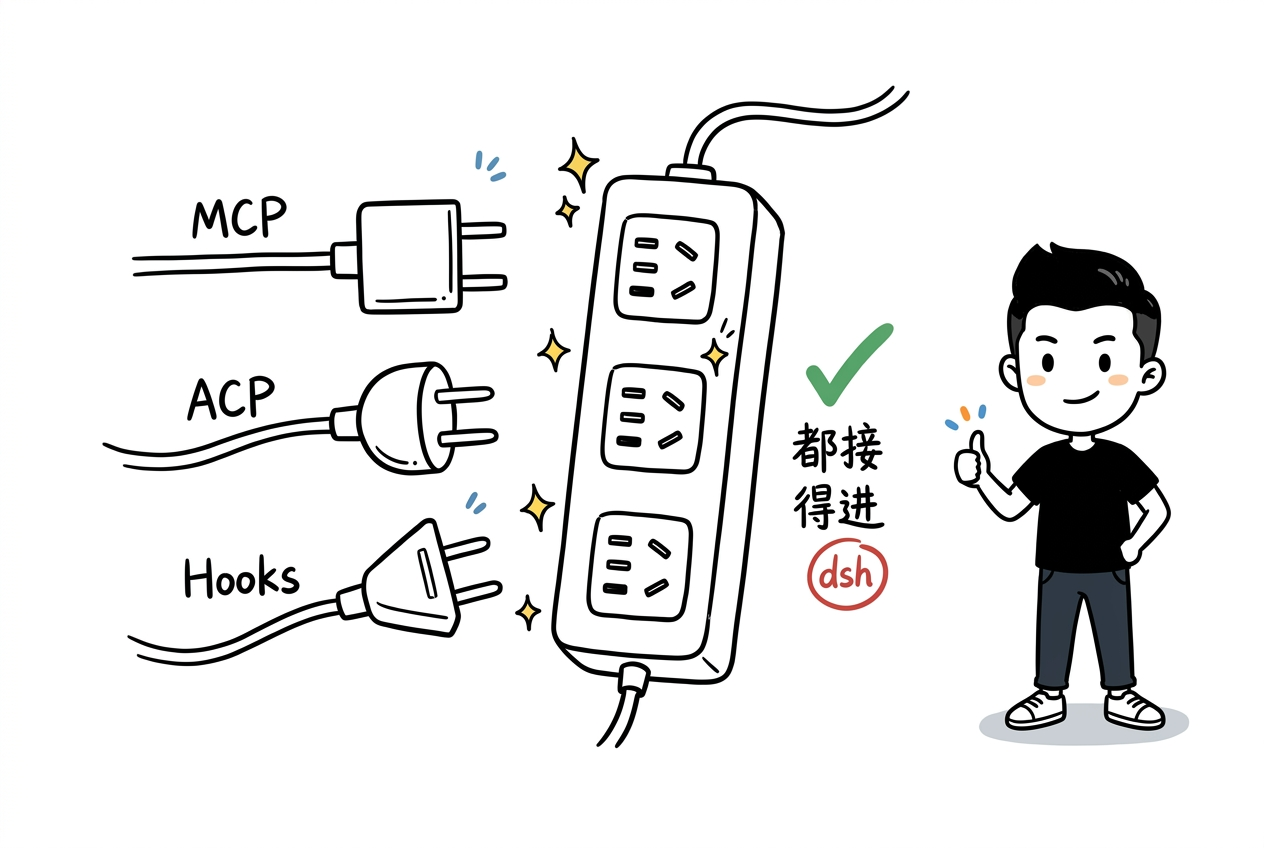 MCP / ACP / Hooks — all plug into dsh
Multi-agent and ecosystem: subagents, forks, and workflows are all plugins; dsh consumes MCP, serves ACP, and bridges Claude Code and Codex Hooks — your existing hook scripts don't get rewritten.
What's actually new
Talk is cheap. Compare with what exists.
I put dsh against three mainstream targets: Claude Code, Codex CLI, and OpenHands.
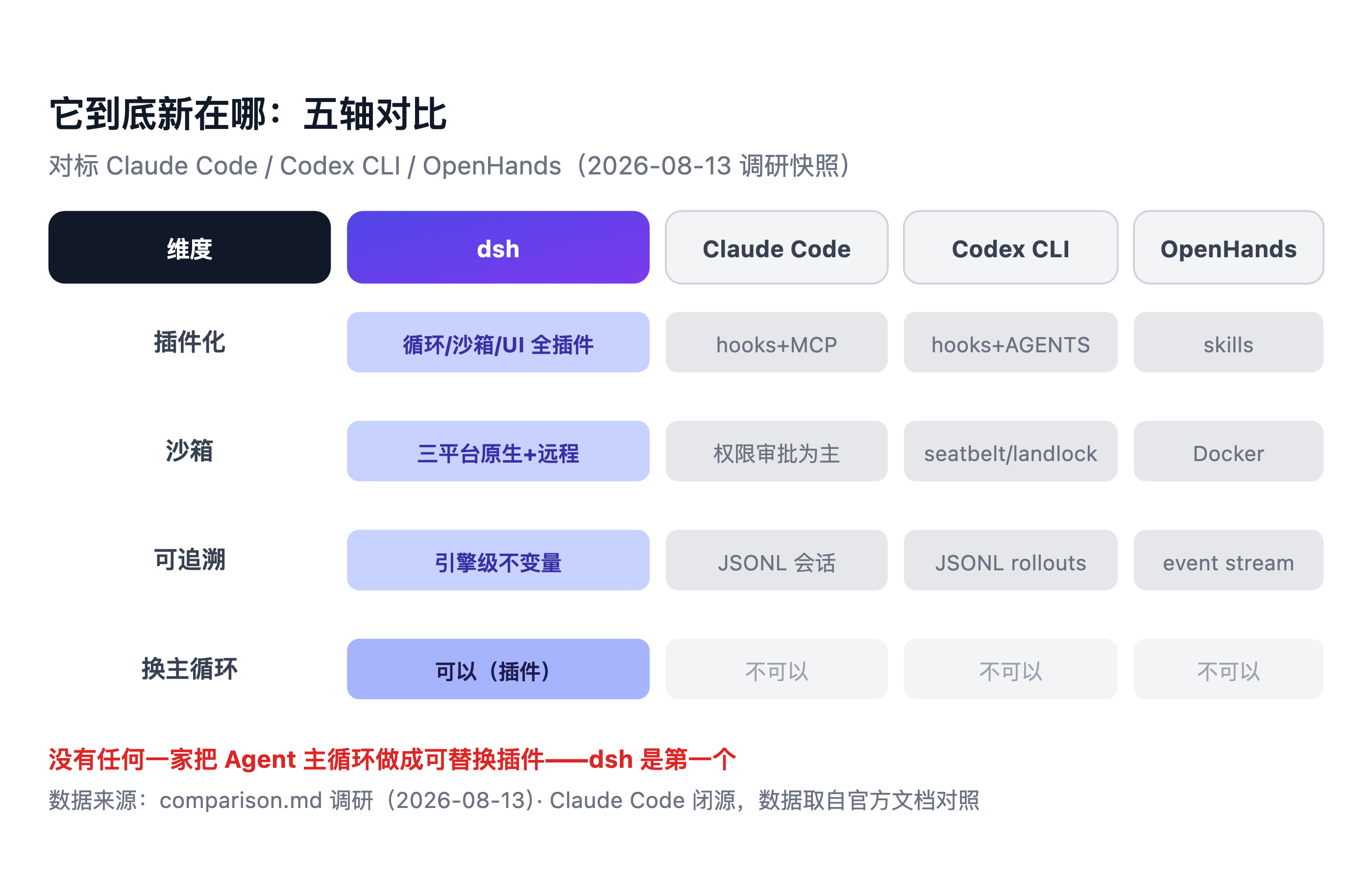 Five axes: plugin depth / sandbox / traceability / modes / open-source
The differences that matter:
- Plugin depth: Claude Code has Hooks and MCP, Codex has AGENTS.md, OpenHands has skills. But none of them make the agent loop itself a replaceable plugin. dsh is the first.
- Sandbox: Claude Code and Codex lean on permission prompts; OpenHands uses Docker. dsh ships native isolation on three platforms (Landlock/bwrap on Linux, Seatbelt on macOS, ACL on Windows), with three permission levels (read-only / workspace-write / danger-full-access). And "partial enforcement is reported honestly" — platforms that can't do it fully say
partial, no pretending. - Traceability: everyone logs. dsh makes "model-visible = logged" an engine-level invariant, not product-layer design.
- Open-source: Claude Code is closed. Codex is open. dsh is MIT — and hit 17.8k+ stars the day it launched.
One line: on "taking the agent apart," dsh goes further than anyone.
Strategy: what is DeepSeek actually doing
Technical depth isn't the whole story. Look at the people.
The dsh team lead is 崔添翼 (@tianyi), formerly 9 years at Jane Street in quantitative trading, co-founder of TSY Capital. The media read (36Kr): "DeepSeek is using the rigor of building trading systems to build the agent execution layer."
That background isn't gossip. It explains a lot of dsh's design:
- The obsession with traceability (a trading system can never afford to be unable to say which trade went wrong)
- The insistence on fail-loud, no silent degradation (missing provider, unknown event type — all loud rejects)
- The harsh engineering gates (more on this below)
Timing matters too: dsh launched the same day DeepSeek released V4-Pro. A "model + Harness" combo on the same day is a clear signal — DeepSeek isn't content to sell model APIs. It's competing for the agent execution layer.
The open question (InfoQ's): will dsh become DeepSeek's own coding product, or the common under-layer of many agent products? Too early to say.
Cold water
Praise done. A few honest warnings. I don't like hype.
 Stay level-headed
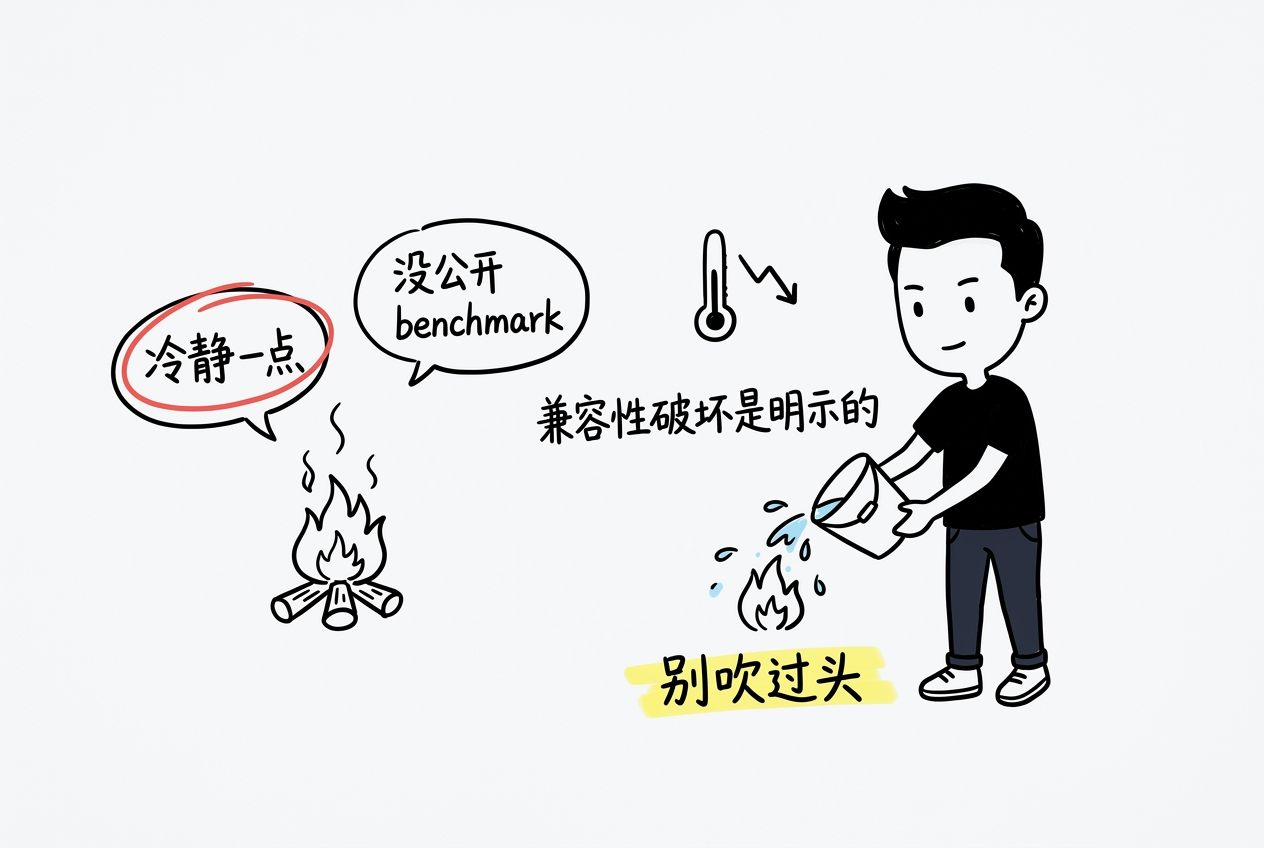
"Anything can be swapped" doesn't automatically mean better results. Value comes from the quality of default plugins, stable composition patterns, credible benchmarks, and third-party ecosystem. Plugins buy you room to differentiate; they don't deliver it.
No multi-agent paradigm breakthrough. It's hierarchical Supervisor–Worker — parent decomposes, child executes. New enough, but it's not Swarm (autonomous discovery, negotiation, competition, dynamic takeover). InfoQ's line is fair: "calling it a revolutionary multi-agent architecture oversells it."
No public benchmarks. I checked BENCHMARK.md myself. It explains how to run benchmarks. It publishes zero results. And it built a Minimal mode specifically for benchmarking, yet publishes no numbers — deliberate or not ready, worth watching.
Breaking changes are explicit. It's v0.1. The README literally says THERE WILL BE COMPATIBILITY-BREAKING CHANGES. Early adopters, your migration cost won't be trivial.
Plugins have a price. Interface stability, dependency management, version compat, performance overhead, debugging complexity. The deeper you carve, the harder these get.
My first run (the honest version)
I wanted to write "it works, it's great." Honest version: it didn't run.
npx @deepseek-ai/dsh@0.1.0-rc.6 web installed fine (100+ packages), but the dsh command didn't land in PATH. Calling bin.js directly hit ERR_MODULE_NOT_FOUND (a js-yaml ESM resolution issue). That's the real rc.6 install experience.
That is the preview reality: the README explicitly warns of breaking changes, and this is exactly the kind of thing I hit. No sugarcoating — v0.1's install experience is rough. To get it running you'd build from source (pnpm install && pnpm run build), which needs a chunk of dependencies and disk I didn't have on this machine.
This is also why 17.8k stars don't make me drop my guard — hype is hype, engineering maturity is another thing.
Close
One sentence for the whole article: Agent performance = model + the layer around it, and that layer is usually ignored.
dsh offers three answers worth stealing:
- Even the loop is a plugin — change retry policy without waiting for upstream
- PTC redefines the tool surface the model sees — announced surface = callable surface; intermediate values never enter context
- Model-visible = logged — when it dies, you stop guessing
It's not mature yet, but the thinking is worth a look — even if all you're doing is finding an agent in your own toolchain that you can change and trace.
Which of the three pains is your current framework hitting? I'd love to hear.
🥚 Easter egg: while reading the source I found its engineering gates are brutal — per-file 100% line coverage, doc drift blocks CI, cross-file clone detection. Next post can explore where the confidence to keep breaking compatibility at v0.1 comes from. Stay tuned.
— Booker